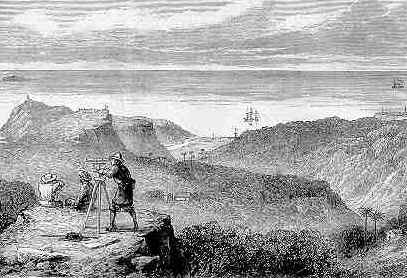
Ein Venustransit ist ein seltenes astronomisches Ereignis, bei dem der Planet Venus exakt zwischen der Erde und der Sonne hindurchzieht. Seit dem Jahr 1761 hat dieses Schauspiel nur fünfmal stattgefunden. Es tritt in Paaren im Abstand von acht Jahren auf, gefolgt von einer Pause von über einem Jahrhundert
A transit of Venus is a rare astronomical event in which the planet Venus passes directly between the Earth and the Sun. Since 1761, this spectacle has occurred only five times. It happens in pairs eight years apart, followed by a gap of over a century.
Die Daten aller Transite seit 1761 - The dates of all transits since 1761:
- 6 June 1761
- 3 June 1769
- 9 December 1874
- 6 December 1882
- 8 June 2004
- 5/6 June 2012
Ich habe bereits einiges zum Transit der Venus hier in meinem Blog gepostet, das meiste bezog sich auf Pingré's Mission in Rodrigues im Jahr 1761, und ziemlich viel auch zum Transit-Ereignis im Jahr 2012.Wenig bis gar nichts bislang zu den Transit-Ereignissen dazwischen, woran mich diese Fundsache erinnerte, ein Ersttagsbrief aus dem Jahr 2004...
I've already posted quite a bit about the transit of Venus here on my blog, most of it relating to Pingré's mission to Rodrigues in 1761, and quite a bit about the transit event in 2012 as well. Little to nothing so far about the transit events in between, which this find reminded me of – a special first-day cover from 2004...

8 June 2004: Transit de Venus – Ile Maurice et Rodrigues
Source: Mauritius Philatelic Corner/Stamps of Mauritius 2000-2009
"Dieser Gedenkumschlag wurde anlässlich des Venustransits herausgegeben, einem astronomischen Ereignis, bei dem die Venus die Umlaufbahn von Sonne und Erde kreuzt. Er findet alle 122 Jahre paarweise statt, mit einem Abstand von acht Jahren zwischen den Durchgängen. Der letzte Zyklus ereignete sich 1874 und 1882.
Der Umschlag zeigt eine allegorische Darstellung des Venustransits. Für diesen Gedenkumschlag wurden drei Briefmarken der Sternbild-Serie verwendet. Sie zeigen die markantesten Sternbilder, die im Südwinter sichtbar sind.
Der Umschlag wurde in Port-Mathurin, Rodrigues, mit einem Sonderstempel frankiert, der Pointe Venus zeigt, wo in der Vergangenheit Venustransite beobachtet wurden."
"This commemorative enveloppe was issued to mark the Transit of Venus, an astronomical event, in which Venus crosses the path the sun’s and the earth’s orbit. It occurs in pairs every 122 years with an interval of 8 years between each passage. The last cycle was in 1874 and 1882.
The cover depicts an allegoric representation of the Transit. Three stamps, from the Constellation issue were used for this commemorative cover. They are the most prominent constellations observed during the austral winter.
The enveloppe was franked at Port-Mathurin, Rodrigues, with a special cachet showing Pointe Venus where Transit observations were made in the past."
Hier nochmal eine zusammenfassende Rückschau - Here's a summary review

Abbé Guy Pingré
Der Transit der Venus, beobachtet vom französischen Astronomen Abbé Guy Pingré auf der Insel Rodrigues, fand am 6. Juni 1761 statt, als die Venus als winziger schwarzer Punkt direkt vor der Sonne vorbeizog. Abbé Pingré und sein Team wurden von der Académie des Sciences entsandt, um dieses historische Ereignis von Rodrigues aus zu beobachten. Daher ist der Ort, an dem er seine Instrumente aufstellte, noch heute als Pointe Vénus bekannt. Astronomen aus aller Welt versammelten sich an über 60 Standorten der Erde, um dieses Ereignis zu verfolgen und die Entfernung zwischen Erde und Sonne, die als Astronomische Einheit (AE) bezeichnet wird, zu berechnen. Da das Wetter ungünstig war, waren Pingrés Beobachtungen historisch weniger bedeutsam wegen der Kartierung der Venusbahn vor der Sonne, sondern vielmehr, weil sie einige der frühesten Aufzeichnungen über die einzigartige Flora und Fauna der Insel lieferten, die er während seines Aufenthalts observierte.
The transit of Venus observed by the French astronomer Abbé Guy Pingré on Rodrigues Island took place exactly on June 6, 1761when the planet Venus passed as a tiny black dot directly in front of the Sun. Abbé Pingré and his team were sent by the Académie des Sciences to observe this historic event from Rodrigues Island. Because of this, the location where he set up his instruments is still known today as Pointe Vénus. Remember? Astronomers from all over the world gathered at over 60 sites to track this event to calculate the distance between the Earth and the Sun, which is known as one astronomical unit. As the weather was not favourable, Pingré’s observations were historically less significant for mapping out the tiny planet's path across the Sun but more for providing some of the earliest notes on the island's unique flora and fauna which he observed during his stay.

1874 - Rodrigues
Beim nächsten Venustransit am 9. Dezember 1874 waren Astronomen diesmal auf Rodrigues sowie auf sowohl auf Mauritius vertreten.Wieder unternahmen wissenschaftliche Teams während des Transits weltweit massive Anstrengungen, um die Entfernung zur Sonne neu zu berechnen. Die beiden Inseln spielten dabei eine zentrale Rolle.
Eine offizielle, hochgradig ausgerüstete britische Expedition unter der Leitung von Lieutenant Neate war auf Rodrigues. Sie bauten Stationen an Orten wie Point Venus und Pt. Coton auf. Im Gegensatz zu früheren Versuchen hatten die Forscher auf Rodrigues im Jahr 1874 hervorragendes, klares Wetter und konnten den Transit perfekt dokumentieren.
Zusatzforschung: Die Expedition wurde von Naturforschern wie Henry Slater begleitet, die die Wartezeit nutzten, um in den Kalksteinhöhlen von Plaine Corail nach Skeletten ausgestorbener Tierarten, wie dem Rodrigues-Solitär, zu graben.
During the next transit of Venus on December 9, 1874, astronomers were present on Rodrigues Island as well as on Mauritius. Once again, scientific teams worldwide undertook massive efforts during the transit to recalculate the distance to the sun. The two islands played a central role in this endeavor.
An official, highly equipped British expedition led by Lieutenant Neate was on Rodrigues. They established stations at locations such as Point Venus and Point Coton. Unlike previous attempts, the researchers on Rodrigues in 1874 enjoyed excellent, clear weather and were able to perfectly document the transit.
Additional research: The expedition was accompanied by naturalists such as Henry Slater, who used the waiting time to excavate the limestone caves of Plaine Corail in search of skeletons of extinct animal species, such as the Rodrigues solitaire.

Site diagram of Belmont/Mauritius showing the heliometer room (A), photo room (B), transit room (C), double image micrometer location (D), 4-inch telescope room (E), alt-azimuth room (P), stone pillar with heliotrope (F), and 3-inch telescope location (Y), and miscellaneous stone pillars (Z).
Auf Mauritius befand sich hingegen auf privatfinanzierter Luxus-Expedition der wohlhabende britische Astronom Lord Lindsay (James Ludovic Lindsay). Zu seinem hochkarätigen Team gehörte auch der berühmte Astronom David Gill. Lindsay errichtete seine private Sternwarte in Belmont (in der Nähe von Goodlands). Am Tag des Transits gab es auf Mauritius leider einige störende Wolken.
Weil das Wetter beim Venustransit enttäuschte, nutzten Lindsay und Gill ihre Instrumente (wie das Heliometer), um stattdessen den Asteroiden Juno zu beobachten. Diese alternative Methode zur Entfernungsbestimmung im All erwies sich im Nachhinein als der eigentliche, große wissenschaftliche Erfolg der Mauritius-Reise. Die Überreste dieser Sternwarte in Belmont sind heute ein geschütztes Nationalmonument.
On Mauritius, however, the wealthy British astronomer Lord Lindsay (James Ludovic Lindsay) was on a privately funded luxury expedition. His distinguished team included the renowned astronomer David Gill. Lindsay had established his private observatory in Belmont (near Goodlands). Unfortunately, on the day of the transit, some clouds obscured the view over Mauritius.
Because the weather was disappointing during the Venus transit, Lindsay and Gill used their instruments (such as the heliometer) to observe the asteroid Juno instead. This alternative method of determining distances in space proved to be the true, great scientific success of the Mauritius expedition. The remains of this observatory in Belmont are now a protected national monument.

Nach dem riesigen Aufwand von 1874 blieb es auf den beiden Inseln im Jahr 1882 astronomisch gesehen ruhig, da der Transit größtenteils stattfand, als die Sonne auf den Maskarenen bereits untergegangen oder gar nicht mehr sichtbar war. Da die geometrische Konstellation bereits vprher klar war wurden Expeditionen mit teurem Gerät von den weltweiten Astronomie-Verbänden in völlig andere Regionen geschickt, wie z.B. Nord-und Südamerika.
After the enormous effort of 1874, astronomically speaking, things remained quiet on the two islands in 1882, as the transit largely occurred when the sun had already set or was no longer visible on the Mascarene Islands. Since the geometric configuration was already clear beforehand, expeditions with expensive equipment were sent by the world's astronomical societies to completely different regions, such as North and South America.

Die Wissenschaftler kehrten erst über ein Jahrhundert später – zum nächsten Transitpaar in den Jahren 2004 und 2012 – mit moderner Ausrüstung (unter anderem Teams der NASA) nach Mauritius und Rodrigues zurück. Diesmal reisten Forscher jedoch nicht mehr an, um mühsam Distanzen zu berechnen, sondern um historische Phänomene mit modernster Technik zu erforschen und das seltene Ereignis live zu dokumentieren.
Am 8. Juni 2004 stand die Region um die Maskarenen geometrisch absolut perfekt, um das Spektakel von Anfang bis Ende zu beobachten. Namhafte Organisationen wie die US-amerikanischen Ring of Fire Expeditions (unter der Leitung des NASA-Spezialisten Paul D. Maley vom JSC Astronomical Society) reisten gezielt nach Mauritius.
Maley baute seine High-Tech-Teleskope in Flic-en-Flac auf. Sein primäres Ziel war es, historische Daten direkt mit modernen Aufnahmen zu vergleichen. Er untersuchte unter anderem Berichte von Lieutenant Hoggan (der 1874 auf Rodrigues stationiert war), um optische Phänomene wie den berüchtigten „Tröpfcheneffekt“ (Black Drop Effect) und die feine atmosphärische Aura um die Venus neu zu analysieren. Unter strahlend blauem Himmel konnten hochauflösende Bildserien und Messungen durchgeführt werden. Auch auf Rodrigues wurde das Event von wissenschaftlichen Enthusiasten und Einheimischen an geschichtsträchtigen Orten wie der Pointe Vénus verfolgt.
Scientists didn't return to Mauritius and Rodrigues until over a century later—for the next transit pair in 2004 and 2012—with modern equipment (including NASA teams). This time, however, researchers didn't travel there to painstakingly calculate distances, but rather to study historical phenomena using state-of-the-art technology and document the rare event live.
On June 8, 2004, the region around the Mascarene Islands was geometrically perfectly aligned to observe the spectacle from beginning to end. Renowned organizations such as the US-based Ring of Fire Expeditions (led by NASA specialist Paul D. Maley of the JSC Astronomical Society) traveled specifically to Mauritius.
Maley set up his high-tech telescopes in Flic-en-Flac. His primary goal was to directly compare historical data with modern images. He examined, among other things, reports by Lieutenant Hoggan (who was stationed on Rodrigues in 1874) to re-analyze optical phenomena such as the infamous "black drop effect" and the subtle atmospheric aura around Venus. High-resolution image sequences and measurements were taken under a brilliant blue sky. On Rodrigues, the event was also observed by scientific enthusiasts and locals at historically significant sites such as Pointe Vénus.

Der Transit von 2012 war für die Menschheit ein ganz besonderer, da es sich um den letzten Venustransit bis zum Jahr 2117 handelte. Die Bedingungen auf Mauritius und Rodrigues waren 2012 deutlich schwieriger als acht Jahre zuvor. Nur das letzte Ende des Transits war in den frühen Morgenstunden kurz nach Sonnenaufgang über dem Indischen Ozean sichtbar. Anstatt eigene gigantische Stationen vor Ort aufzubauen, nutzten lokale Bildungsreinrichtungen und Forscher auf Mauritius das Event für weltweite Bildungsprojekte. Die Daten wurden mit den hochauflösenden Live-Bildern von Weltraumteleskopen (wie dem Solar Dynamics Observatory der NASA) abgeglichen. So wurde sichergestellt, dass trotz der kurzen Sichtbarkeitsfenster auf den Inseln präzise Beobachtungen für die Nachwelt festgehalten wurden.
The 2012 transit was a truly special event for humanity, as it was the last transit of Venus until the year 2117. Conditions on Mauritius and Rodrigues were significantly more challenging in 2012 than they had been eight years earlier; only the final phase of the transit was visible over the Indian Ocean during the early morning hours, shortly after sunrise. Instead of constructing massive observation stations on-site, local educational institutions and researchers on Mauritius used the event for global educational projects. The data were cross-referenced with high-resolution live images from space telescopes (such as NASA’s Solar Dynamics Observatory). This ensured that, despite the limited visibility windows on the islands, precise observations were recorded for posterity.
Related:
- Transit of Venus.....Greetings from a black dot/08.06.2012
- Rodrigues and the Transit of Venus 2012/ 07.06.2012
- Chasing the Venus....Pingré in Rodrigues/05.06.2012
- Wenn die Venus sich vor die Sonne schiebt...When Venus moves across the sun.... / 05.06.2012
More on the Transit of the Venus 2004
THE GREAT TRANSIT OF VENUS EXPEDITION TO MAURITIUS JUNE 8, 2004 By Paul D. Maley, NASA Johnson Space Center Astronomical Society, Houston, TX USA
More on First Day Covers issued in Mauritius:
- Mauritius Philatelic Corner/Stamps of Mauritius