Posts mit dem Label Reserve Francois Leguat werden angezeigt. Alle Posts anzeigen

Samstag, 26. September 2015

Tropicbirds....Paille-en-Queue à Anse Quitor


Heute mal auf die Schnelle ein paar Fotos von ein paar Tropikvögeln, die Sophie und ich bei unserem Besuch vor 4 Wochen in Anse Quitor gemacht haben.-

Today some pics of Tropicbirds which were taken by Sophie and me about 4 weeks ago during our visit of the Reserve Francois Leguat at Anse Quitor.-

Aujourd'hui quelques images des Pailles-en-Queue pris pendant une visite de la Réserve Francois Leguat à Anse Quitor.
Photo: Sophie Vankerckhoven
Wie man unschwer sieht, sind es keine professionellen Fotos, aber wir waren schon glücklich, wenn auf ein paar wenigen Aufnahmen (von Dutzenden) die Vögel als solche schon identifizierbar waren....:))-

As one can see easily, these are not professional shots, but we were already happy when on some photos (out of dozens taken) at least some were recognisable as Tropicbirds...:))-

Comme on peut constater sans difficulté, les photos ne sont pas d'une qualité professionelle, mais nous étions déjà contents quand sur quelques unes (des douzaines prises) les oiseaux étaient au moins identifiables...:))


Geduld und vor allem ein besser niemals steifwerdender Nacken sind vonnöten...-
Patience and especially a neck which never gets stiff are in high demand...-
Patience et une nuque qui ne devient jamais raide sont demandé...

Photo: Sophie Vankerckhoven

Tropikvogel beim Felsspalten-Landeanflug -
Mit einer besseren Kamera wäre das wahrscheinlich eine Super-Aufnahme geworden... -


Tropicbird shortly before landing in one of the fissures-
With a better camera this would have probably been a fantastic photo...-


Paille-en-Queue en préparation d'atterrissage dans une crévice-
Probablement avec une meilleure camera cela aurait été une super photo...


Ein bisschen Glück und Perspektivenänderung gehören auch dazu, dann sieht man, was die Felsspalten in dieser Jahreszeit so interessant macht ...-

With a little luck and some change of prospective one can see what makes the fissures so interesting at this time of the year...-

Avec un peu de la chance et du changement de perspective on peut voir pourquoi les crévices sont si attractives pendant cette période de l'année...


Es ist Paarungszeit...-
It's time to mate...-
C'est la période des couples...


Wir hatten wirklich Glück und konnten an diesem Morgen einige bei ihren Paarungsflügen beobachten. -

We were really lucky this moning as we could observe quite a lot of birds during their aerial displays which happen only during breeding season.-

Nous étions vraiment privilegiés ce matin car nous avons pu observer pas mal des oiseaux pendant leurs vol en couple, un phénomène qui peut se voir que dans cette période.

Photo: Sophie Vankerckhoven

Normalerweise lebt der Tropikvogel allein.-
Usually the Tropicbirds lives solitary.-
Normallement le Paille-en-Queue mène une vie en solitude. 


Und hier der Blick auf das Tal von "Francois Leguat", von wo aus wir die Vögel beobachtet und fotografiert haben.-And this is a view on the valley of the Reserve Francois Leguat from where we took the pics...-
Et ici la vue sur le park de la Réserve Francois Leguat d'où nous avons pris les photos...

----------------

You can find a longer and more detailed article about Tropicbirds and their behaviour here in German and English. However, here some fast facts.

- The White-tailed Tropicbird (Phaethon lepturus) can be recognised by the long white tail feathers
   and its yellow bill.
- It lives solitary in habit.
- Pairs exhibit aerial displays during breeding season.
- First breeding attempts at 2–5 years of age.
- Average adult weight 350g.
- Average lifespan: appr.16-20 years

In comparison:
- The red-tailed tropic bird (Phaethon rubricauda) has a longer tail
- Red-tailed Tropicbird can  easily be distinguished by its long red tail feathers and red
 bill
- It lives solitary in habit.
- Pairs exhibit aerial displays during breeding season.
- Average adult weight 800g
- Average lifespan is16 years 

Both species breed on the main land and possibly on the islets of Rodrigues. 
(source)

More on Tropicbirds:

Donnerstag, 22. August 2013

Ein etwas anderes Geburtstagsgeschenk...Meet Anka the Tortoise


Rückblick/Review
 20. August 2012

Montag vor einer Woche war Feiertag hier, das Ende von Ramadan machte es möglich... ein Besuch des Schildkrötenparks in Anse Quitor, Heimat für mittlerweile mehr als 1000 Riesen-Schildkröten. Begleitet hat mich Kathy aus England, die seit 5 Jahren regelmäßig hierherkommt. Erst etwas über eine Stunde mit dem Bus, dann noch etwas laufen...-

Last week on Monday was a holiday in Rodrigues, thanks to Eid Mubarak, the end of Ramadan, I had the chance to visit again the Reserve Francois Leguat in Anse Quitor, home to now more than 1000 giant tortoises. Kathy from England who has been coming to Rodrigues for now 5 years was decided to come with me and was very good company. Only a little over an hour by bus, then walking a short distance...

Photo: Kathy O'Keeffe

Vorbei an Häusern mit Open Air Spülbereich....-
Passing houses with open air washing up departments...

Photo: Kathy O'Keeffe

Und Häusern...-
And houses...

 
 Photo: Kathy O'Keeffe

Mit Hunden, die auf eine Bootspartie warten...-
With dogs waiting for a boat trip...

Photo: Kathy O'Keeffe

Vorbei auch an dürren Rindern mit Gefühl...-
Passing some skinny but good-natured cattle too

 
Photo: Kathy O'Keeffe 
   
 Diesmal gab es eine Abkürzung...-
And this time there was a shortcut ... 

 Photo: Kathy O'Keeffe

Es ist immer gut, wenn man Insider trifft, in diesem Fall eine Führerin des Parks, die auf dem Weg zur Arbeit war...-
It's always good to meet insiders, in this case a guide of the Reserve...))

Photo: Kathy O'Keeffe

Wenn Wurzeln wachsen, wie sie wollen, ist es nicht mehr weit...-
When roots grow as they wish without being disturbed, then it is not far anymore...


Da ist sie.-
There she is.


 Ja sie.-
Yes she.


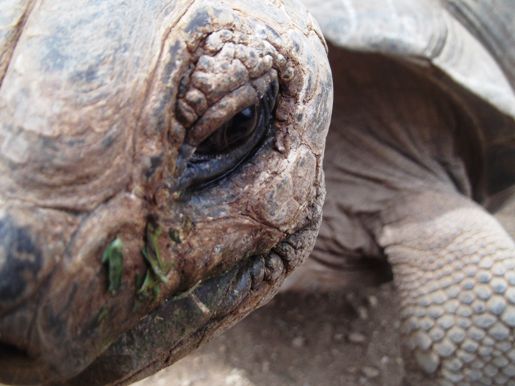
Sie hatte noch etwas Grünzeug um die Nase.-
With some green stuff still around her nose.


Sie ließ sich nicht beirren und kam bedächtig aber zielstrebig näher...-
She was undaunted and came slowly but purposefully closer....


Sie zeigte mir ihren Panzer....-
She showed me her carapace.

Und wie man ihrem Gesicht ablesen kann, wusste sie ganz genau, dass sie es geschafft hatte, adoptiert zu werden, ihr gefiel es gut, ein Geburtstagsgeschenk für eine Freundin zu sein...!-

And one can see it in her face, she knew exactly that she has managed to get an oversea auntie!
She liked it very much to be a birthday surprise for a good friend...

Anka
Photo: Reserve Francois Leguat

Hier einige Fakten über mich:

Ich bin eine Riesenschildkröte mit Wurzeln auf dem Aldabra-Atoll, das zu den Seychellen gehört.
Seit dem 22. August 2012 höre ich auf den Namen ANKA.
Im Jahr 2007 kam ich von Mauritius per Schiff nach Rodrigues, nach meiner Ankunft in Anse Quitor hatte ich nur ein Gewicht von 18 kg.
Im Oktober 2012 wog ich bereits 45 kg. -


Here some facts about me:
I am a giant tortoise with roots on the Aldabra-Atoll which belongs to the Seychelles.
Since August 22 in 2012 I hear on the name of ANKA
Coming from Mauritius by boat I arrived in the reserve in 2007, I was weighing then only 18 kg.
In October 2012 I was weighing already 45 kg.


Ich habe bis Februar 2013 nochmal 2,3 kg zugelegt, das macht also 47,3 kg.
Ich bin bei guter Gesundheit und heute bin ich zwischen 17 und 20 Jahre alt, es wird also noch einige Zeit dauern, bis man weiß, ob ich ein Mädchen oder ein Junge bin ...-


I put on another 2.3 kg until February 2013, so that makes 47.3 kg.
I am in good health and today I am between 17 and 20 years old, so still for quite some time nobody will really know if I am in fact a girl or a boy...

Photo: Reserve Francois Leguat

OK, das bin ich. -
OK, that's me.


Und das ist meine Patentante in Deutschland.
Sie mag Schildkröten.
And that is my auntie in Germany. 
She likes tortoises...

Photo: Kathy O'Keeffe

 Aber mein Gehege ist etwas größer...
  But see, my enclosure is much bigger....

 Photo: Reserve Francois Leguat

Aber darum geht es heute nicht, eigentlich wollte ich nur gratulieren, 
denn es ist wieder Geburtstagszeit..., 
ein Jahr mehr in dem ich wachsen kann unter den Augen meiner Patentante...-.

But today it's not about me, as it is b-day time again.
time for another year in which I can put on weight under the eyes of my auntie in Germany...
 
Not 48.1 kg (as so much weighs Anka today) but a nice cake anyway...
source

Happy Birthday, Britta-Gudrun, have a wonderful day today!


PS:
Und wer sich fragt, wer denn eigentlich Kathy ist und wo sie abgeblieben ist...-
Somebody looking for Kathy? Here she is...
Wenn sie nicht gerade dabei war Nene, meine adoptierte Schildkröte zu filmen, die an diesem Tag sehr anhänglich war und mir auf Schritt und Tritt folgte,...-

When she was not busy filming Nene, my adopted tortoise who was very affectionate and clinging on that day from the moment we entered the enclosure...
 
...krabbelte sie auf dem Boden herum und schloss Freundschaft mit weiteren Adoptionskandidaten!
She was just making friends with other potential candidates for adoption...

Mittwoch, 23. Mai 2012

World Turtle Day....Ein Hoch allen Schildkröten dieser Erde


Aldabra Tortoise at the Reserve Francois Leguat in Anse Quitor/Rodrigues
Photo: Matthias Muencheberg 

Heute ist Welt-Schildkröten-Tag. Initiiert durch American Tortoise Rescue und ausgerufen durch die Human Society of the United States wird dieser Tag seit dem Jahr 2000 begangen um auf die Bedrohung dieser Tiere aufmerksam zu machen, die bereits seit mehr als 200 Millionen unsere Erde und Ozeane bevölkern und damit die ältesten Kreaturen überhaupt sind. Doch durch Wildern, Fischindustrie, Umweltverschmutzung, Lebensraumzerstörung und dem Handel mit Schildkröten als Haustiere ist die Zukunft dieser sanften Tiere im Wasser und zu Land ungewiss. Ältere ausgewachsene Tiere verschwinden zunehmend in der freien Natur, sodass die Fortpflanzung vieler Arten nicht mehr gewährleistet ist, manche Schildkröten werden erst mit 50 Jahren geschlechtsreif. Von 328 bekannten Arten auf der Welt gelten mehr als die Hälfte als gefährdet oder sind vom Aussterben bedroht.

“World Turtle Day was started 12 years ago to increase respect and knowledge for the world’s oldest creatures. These gentle animals have been around for about 200 million years, yet they are rapidly disappearing as a result of the exotic food industry, habitat destruction and the cruel pet trade,” says Tellem. “We are seeing smaller turtles coming into the rescue meaning that older adults are disappearing from the wild, and the breeding stock is drastically reduced. It is a very sad time for turtles and tortoises of the world.” (source)

Kindergarten at Anse Quitor
Photo: S/Y Chaotic Harmony

"The earliest turtles evolved up to 300 million years ago, branching off from a group of reptiles more closely related to crocodiles and birds than to lizards and snakes. Lots of turtle species have come and gone since then, including some spectacular ones like the car-sized "coal turtle" or the Koopa-like Meiolania damelipi.

But today's turtles face an unusually widespread danger, with about half of Earth's 328 known species listed as threatened or endangered with extinction. 
Poaching for food and for the international pet trade are two of turtles' biggest threats, especially for certain high-demand species like the American bog turtle or the Roti Island snake-necked turtle. Habitat loss is another problem, since many turtle and tortoise species depend on specific ecological niches. Land turtles are also frequently killed by vehicles on roads, while sea turtles face a litany of risks such as oil spills, boat strikes and entanglement in fishing gear. Slow growth and reproduction rates can make it even harder to overcome these hurdles.
In light of all this, May 23 is World Turtle Day, an annual holiday founded in 2000 by American Tortoise Rescue to raise awareness of turtles' troubles "with the ultimate goal to stop the illegal trade in turtles and tortoises around the world."

Find here the whole article including a few tips & a collection of 12 amazing turtle photos with information about their current status!!!

Younger Aldabra Tortoises at Anse Quitor in September 2011
Photo: S/Y Chaotic Harmony

And now let's focus on the status of the two species of giant land tortoises introduced in 2007 in Rodrigues, the Aldabra Giant Tortoise and the Radiated Tortoise...


Anders als die Galápagos-Riesenlandschildkröte, Flagschiff-Spezies im Kampf für die Erhaltung der verbleibenden Unterarten, (die noch bei einer Zählung 1974 nur um die 3000 verbliebene Exemplare aufwies, mittlerweile sind es knapp 20 000), die ohne die Hilfe von Naturschützern, der Einrichtung von Brutstationen und Reservaten, striktem Ausfuhrverbot vermutlich bereits ausgestorben wäre, gilt der Bestand und das Überleben der Aldabra Riesenschildkröte des Aldabra Atolls, das zu den Seychellen gehört, mit einer frei lebenden Gesamtpopulation von etwa 100 000 Tieren, und damit als einziger Riesenlandschildkröte, als vergleichsweise gesichert.Hinzu kommen ca.5000 Tiere in Zoos und Privathand.

Allerdings könnten aufgrund des kleinen Verbreitungsgebietes Naturkatastrophen, Seuchen und Menscheneinwirkung einschneidende Auswirkungen haben. Die Aldabra-Riesenschildkröte ist in Anhang B der Europäischen Artenschutzverordnung als gefährdet gelistet. Sie unterliegt damit der behördlichen Meldepflicht, darf aber ohne Vermarktungsgenehmigung ge- bzw. verkauft werden.(Quelle). Ihre größte Bedrohung ist die Klimaerwärmung, da das Atoll nur wenige Meter über dem Meeresspiegel liegt.-

Unlike the Galapagos giant tortoise, flagship species in the struggle for the preservation of the remaining sub-species with a population left in the wild of about only 3000 forty years ago (now about 20 000), which certainly would have been extinct by now without the help of conservationists and a whole set of measures such as the establishment of hatcheries, reserves and strict export ban, the future of the Aldabra giant tortoise looks more reassuring. 
"The main population of the Aldabra giant tortoise resides on the islands of the Aldabra Atoll in the Seychelles. The atoll has been protected from human influence and is home to some 100,000 giant tortoises, the world's largest population of the animal. Another isolated population of the species resides on the island of Changuu, near Zanzbar and other captive populations exist in conservation parks in Mauritius and Rodrigues."

In addition 5000 animals are in zoos and private hands.

However, due to the small distribution area natural disasters, epidemics and human exposure could change the situation quickly. The Aldabra giant tortoise's current IUCN conservation status is 'vulnerable' to extinction.The Aldabra atoll is only a few metres above sea level so the wild tortoises are now being threatened by climate change and rising sea levels.
To aid conservation, the giant tortoises are also being bred in captivity in reserves on the islands of Mauritius and Rodrigues, where they are thriving.

During recent years more and more Aldabra tortoises were reported to be traded as pets, although considering size, required living conditions etc a delicate pet to have, there is evidently a market for legal and illegal trade of these animals.
The once abundant radiated tortoise has disappeared from wide areas of its native habitat in southern Madagascar due to hunting for food and the illegal pet trade.
Credit: Julie Larsen Maher/Wildlife Conservation Society

Als das Konzept zum Schildkröten-Park in Anse Quitor entwickelt wurde, plante man nicht nur die Einführung der Aldabra-Riesenschildkröte, sondern auch die der Strahlenschildkröte, der Radiata aus Madagaskar.Neben dem Wissen, dass beide Arten ähnliche Lebensbedingungen brauchen, wollte man der bereits seit längerem als stark bedrohter Art geltenden Radiata eine Überlebensnische anbieten. Die Strahlenschildkröte gilt als eine der schönsten Landschildkrötenarten überhaupt und sie war noch vor nicht allzu langer Zeit mit einer in die Millionen gehenden Population eine der zahlenmäßig höchst vertretenen Schildkrötenart überhaupt.Die zügellose Jagd auf ihr Fleisch, ihre Eier und der illegale Tierhandel ist in den letzten Jahren so sehr angestiegen, dass man mittlerweile davon ausgeht, dass sie in 20 Jahren ausgestorben sein wird, sofern man nicht mit drastischen Maßnahmen ihr Überleben zu sichern beginnt.Mittlerweile wird selbst vor Naturreservaten in Madaskar kein Halt gemacht um sie zu stehlen, den Einrichtungen fehlt das Personal und das nötige Equipment um die Tiere angemessen zu schützen.-

When the concept for the turtle park in Anse Quitor was developped, it was decided not only to introduce the Aldabra giant tortoise but also the Radiata species from Madagascar, as this land tortoise has been threatened severely already for some time. Radiated tortoises are considered as one of the most beautiful tortoise species and they were once abundant with a population in the millions. Today their future in their natural habitat looks bleak, due to rampant hunting for its meat and the illegal pet trade they are rapidly nearing extinction. Biologists predict that unless drastic conservation measures take place, the species will be driven to extinction within the next 20 years.
(read the whole article)

Radiata hatchlings

Und hier nun die Zahlen des Bestands der Schildkröten im Park Francois Leguat / Stand 23.05.2012

     Total Tortoises:  1794 
  Aldabra Babies:    387 
  Radiata Babies:   897

Since the introduction of tortoises in Anse Quitor (the first ones arrived in October 2006), 1284 little ones hatched which alone is a great success.

Here more about the Reserve Francois Leguat, their activities and tortoise adoption program.As an adoptive mum of one Aldabra tortoise, I can only recommend this wonderful possibility of getting involved and interested in the well-being of this species.

Eivind from Norway and little mate visiting my adopted tortoise Nene in the park who carries the number 302 on her carapace
Photo: S/Y Empire/September 2011

Sources:
- Happy World Turtle Day/Mother Nature Network 22.05.2012
- World Turtle Day/American Tortoise Rescue
- Scientists lift lid on turtle evolution/Mother Nature Network 15.05.2012
Aldabra Tortoises Trade....see here


Related to Rodrigues' Reserve:
- Erster Schildkrötennachwuchs in Anse Quitor/ 26.03.2008 (mit Geschichte des Parks in dt.)
- Lemon Treat/ 02.11.2008
- All about Nene/ picasa photo album

Sonntag, 11. Oktober 2009

Nene...

Nene, meine adoptierte Aldabra-Riesenschildkröte, bekam heute Besuch. Romain, einer meiner Schüler war heute zum ersten Mal im Park Francois Leguat und richtete ihr meine Grüße aus...-

Nene, my adopted giant Aldabra tortoise, had a visitor today. Romain, one of my students, was at the Parc François Leguat for the first time and sent her my greetings...-

Nene, ma tortue géante d'Aldabra adoptée, a reçu une visite aujourd'hui. Romain, un de mes élèves, visitait le parc François-Léguat pour la première fois et lui a transmis mes salutations…


Related:

-  Kindergarten in Anse Quitor.../23.09.2009

-  Mutterschaft einmal völlig anders...!/02.05.2008

Mittwoch, 23. September 2009

Kindergarten in Anse Quitor...

Das ist ein Blick von oben auf den Bereich des Schildkrötenparks in Anse Quitor. So besucht wie auf diesem Foto vom 9. Juli war es letzten Sonntag nicht, normalerweise geht es ruhig zu, aber an diesem Tag waren Schulklassen auf Exkursion im Park.-

Here a view on the Giant Tortoise Reserve in Anse Quitor. Usually it is very calm and peaceful, on this specific day on July 9 pupils from school classes were on excursion. Und hier bin ich mit Nene, meiner adoptierten Aldabra Riesenschildkröte, mit ca. 16 immer noch nicht erwachsen...Am Anfang dachte ich, sie sei eine sie, doch es dauert noch ein paar Jährchen, bis man das wirklich weiß und sehen kann...-

And here you see me with Nene, my adopted Aldabra tortoise of maybe 16 years. In the beginning I thought she was a she but I had to learn that it will take some more years to know it exactly...


Das sind George, Chloé und David von dem Segelboot S/Y Magwen. Letzten Sonntag besuchte ich mit ihnen das Naturreservat in Anse Quitor.-

These are George, Chloé and David from S/Y Magwen. Last Sunday we went to visit the Reserve Francois Leguat at Anse Quitor.

Hier einmal Blick in den Kindergarten der Schildkröten. Insgesamt wurden seit Eröffnung des Parks 342 Schildkrötenbabys geboren, den weit größten Anteil des Nachwuchses stellen die madegassischen Strahlenschildkröten, die Aldabraschildkröte scheint nicht so "gebärfreudig" zu sein... -

Here a look into the kindergarten of the tortoises. Since the park's inauguration 342 little tortoises were born, most of them belonging to the Radiata species from Madagascar, the Aldabra tortoises seem to produce their offspring less fast .Hier kann man den Unterschied zwischen einer kleinen Riesenschildkröte sehen, die letztes Jahr im Januar geboren wurde (links) und einer, die in diesem Jahr geboren wurde. Der Unterschied ist nicht allzu groß...Die Altere war jedoch vorwitziger, einmal auf meiner Hand plaziert, wagte sie auch gleich, mich mit einem kleinen Rinnsal zu beehren...-

Here you see the difference between a tortoise born last year in January (left) and one born this year. Not such a big difference if you ask me...But the older one was more forecoming and mischievous, placed on my hand, she even dared to pee which made me feel honoured...

Und damit die Kleinen auch hübsch wachsen, gab es als Sonntagsfrühstück Früchte und Tomaten...-

And in order to make the baby tortoises grow, fruits and tomatoes were served as Sunday breakfast...
Doch bis sie mal so groß und schwer wie Foetidia werden, wird davon noch viel gefressen werden müssen. Geschlechtsreif werden die Kleinen übrigens erst zwischen 15 und 30 Jahren, solange dauert es auch bis ihr Geschlecht mit dem Auge bestimmt werden kann. Wissenschaftliche Methoden, das Geschlecht bereits früher zu bestimmen, sind nicht nur kostenintensiv, es gibt auch nur 4 Personen weltweit, die darauf spezialisiert sind.Mehr zum Thema ein anderes Mal. -

But it will take not only lots of food to become as big and heavy as Foetidia. Fertility is reached between 15 and 30 years, that's what it takes too to determine their sex with the human eye. Though there are scientific methods to know about it earlier, but it's expensive as there are only 4 known experts worldwide who are specialised in it. More about breeding in a later posting.

Related:
- Mutterschaft einmal völlig anders
- Picasa Album "All about Nene"
- Reserve Francois Leguat

Dienstag, 30. Dezember 2008

The secret man....Oder Zeit, ein Rätsel zu lösen

Ein Eisbär. Der Eisbär schlechthin. Knut. In Berlin. Ein paar Tage vor seinem 2.Geburtstag . -

A polar bear. Just the one and only polar bear with the name of Knut. In Berlin. A few days before his second birthday.

Ein paar Tage früher: Ein Mann im weißen Hemd (neben der Dame in Rot). Steve. Ein Australier in Rodrigues. Anse Quitor um genau zu sein. November 2008. -

A few days before: a gentleman in a white shirt (beside the lady in red). Steve. From Australia, so an Aussie in Rodrigues. To be precise, in Anse Quitor. November 2008.

Oh, nochmal Knut, der Berliner Bär. Und jetzt zusammen mit dem Australier, der erst ein paar Tage zuvor in Anse Quitor gesichtet worden war bei der Einführung eines neuen Buches zu Mauritius und Rodrigues . -

Oh, Knut again, the Berlin bear. And now together with that Aussie who was sighted a few days before in Anse Quitor when a new book was launched there about Mauritius and Rodrigues.

The Lost Land Of The Dodo...,
ein Buch über die Ursprünge unserer Insel, ihrer Natur und ihrer Bewohner...

Nein, Steve ist keiner der Autoren... -

The Lost Land Of The Dodo...,
a book about the origins of our island, the island's nature and inhabitants....

No, Steve is not one of the authors....


Das ist einer der Autoren...Julian Hume, er malte auch die interessanten Bilder wie das im Hintergrund, worauf man sehen kann, wie es in Rodrigues früher ausgesehen haben soll bevor Besiedelung stattfand. Leider konnte Julian Knut nicht besuchen.
Umso dankbarer sind wir Steve.-

This is one of the authors ... Julian Hume, he also painted the interesting pictures as the one in the background, on which one can see how Rodrigues probably had looked before colonization took place. Unfortunately Julian could not visit Knut. The more grateful we are to Steve.


Und das ist das, was Steve Bourne sonst eigentlich macht, wenn er keine Eisbären besucht-
And that's what Steve Bourne usually is doing when not visiting polar bears ...


 Ja, er gräbt in Höhlen herum...
Little interview break after working in one of the caves found at the Reserve Francois Leguat


"G'day from Australia,
Steve the crazy Aussie who promised to photograph Knut when he got to Berlin followed through on the promise. It was minus 2 degrees and snowing and Knut was having a great time, about the only animal in the zoo enjoying the weather. I had an awesome time on Rodrigues, great company and great fun caving and excavating fossils.
The workshop in Germany brought things back to reality, first day 12 hours work. Temp reached 5 one day, it was so cold I could not even drink beer (only joking Lorna!!). ..."

Dave, Greg, Steve, Julian and Lorna

Und hier noch mal schnell das international zusammengestellte Höhlen und Knochen-Team in Rodrigues....Es hat viel Spaß gemacht, sie kennenzulernen und noch mehr Spaß zu sehen, dass Steve sein Versprechen wahrgemacht hat und tatsächlich den Weg zu Knut fand.

And here a pic of the internationally composed cave- and fossil team who came together in November in Rodrigues, some of them not for the first time, and at least one of them left with some new family members...))


Hier ist No.135, sie ist die älteste der weiblichen Schildkrötenbevölkerung in Anse Quitor, mit ihren 75-80 Jahren auf dem Buckel.Gayle heißt sie nun.Was Ruth betrifft, No. 23, ihr geht es gut, aber ich habe leider noch kein Foto von ihr.Sie war von Dave für seine Mutter adoptiert worden.-


Here is No.135, she is by the way the oldest of the female tortoise population at Anse Quitor., somehow between 75 and 80 years of age, and now named Gayle.
.As to Ruth, No. 23, who was also adopted by Dave for his mother, I have not yet a pic, but I confirm that she is well.


1000 thanks to Dave Staudt from California and Steve Bourne for sharing their photos!

Related: