Montag, 30. Juli 2012

Courage Valérie....


Als erstes möchte ich mich entschuldigen für die lange Zeit, in der ich mich hier gezwungenermaßen rar gemacht habe, selbst die Kuchen für Valérie konnten immer nur etappenweise ins Album geladen werden, nichtsdestotrotz heute scheint das Internet zu funktionieren, deshalb zuallererst für alle Freunde von Valérie, die letzten Entwicklungen.

Valérie war ab Donnerstag vorletzter Woche wieder in der Klinik, der Sturz hatte dazu geführt, dass sie nicht mehr sehen konnte.Sie wird nun im Intervall von 14 Tagen an beiden Augen operiert.Die erste Operation fand vorletzten Samstag statt, sie ist gut verlaufen, mit welchem Erfolg für ihre Sehfähigkeit wird man später sehen. Dies ist eine ganz wichtige Etappe für Valérie, die ansonsten eine unglaubliche Entwicklung gemacht gemacht hat. Sie kann sprechen, essen, ohne Hilfe laufen und ihr Gedächtnis funktioniert zu 100%. Die ersten Grüße von ihr gab es auch schon, was mich sehr berührt hat.

Für die erneute Herausforderung wünsche nicht nur ich ihr hiermit alles Gute, die Daumen werden weiterhin gedrückt,  und es gibt auch schon weitere Kuchen, die darauf warten ins Album zu kommen (abgesehen von all den Kuchen, die noch darauf warten untertitelt zu werden...))

First of all I want to apologize for the length of time in which I've made myself scarce, even the cakes for Valerie could only be loaded in stages into the album, nonetheless, today the Internet seems to be working , so first for all friends of Valerie, the latest developments.

Valerie has been again in the clinic, the fall had affected her eye sight, Valérie couldn't see anymore. She has to undergo two operations, one took already place on Saturday the week before.The next one on her right eye is scheduled for probably this week. This is a very important stage for Valerie, who otherwise has made an incredible development. She can talk, eat, walk unaided, and her memory works at 100%. The first greetings from her arrived via her husband André which was a very touching moment.

For this new challenge all her friends and I wish her all the best, the thumbs are up again, and there are more cakes waiting to get into her album (apart from all the cakes waiting to be subtitled  .. .)) -


Valérie in the year 2009 during a local fair in port Mathurin
Photo: James Castel
D'abord toutes mes excuses pour la longueur de temps dans lequel je me suis fait rare ici, même les gâteaux pour Valérie ne pouvait chargés que infréquemment dans son album, néanmoins, aujourd'hui, l'Internet fonctionne, donc d'abord les derniers développements pour tous les amis de Valérie .

Entretemps Valérie a été à l'hôpital encore une fois, la chute a affecté sa vue, elle ne pouvait plus voir.Dans un intervalle de 14 jours elle va subir des opérations dans les deux yeux, la prémière opération était déjà samedi, le 21 juillet. Avec quelle succès on va savoir plus tard. La prochaine opération est prévue probablement pour cette semaine, à l' oeuil droite. Il s'agit d'une étape très importante pour Valérie, qui a fait un développement incroyable.Elle peut parler, manger, marcher sans aide, et sa mémoire fonctionne à 100%. Les premiers compliments d'elle sont arrivés ici , cela m'a touché beaucoup.
 
Pour le nouveau défi non seulement moi lui souhaite tout le meilleur, les doigts restent croisés et nous pensons tous très fort à elle. Et il ya encore plus de gâteaux qui sont en attente pour entrer dans l'album (apart de ceux qui attendent à être sous-titrés .. .)) -

UPDATE 11.08.2012:

I got a message of Valérie, her husband André helped by writing it down, her next operation of which she hopes that it will be the last one, will be this Monday, 13th of August. So all fingers will be crossed!
And she says thanks for all the great support!


Related:

Album sur picasa pour Valérie
(dt./engl./frc.)
- Contact me if you want to leave greetings and a cake for Valérie too, I will be pleased to add it to the album -
 

Samstag, 7. Juli 2012

Der letzte seiner Art....Farewell to Lonesome George

Lonesome George, a Pinta giant tortoise,at the Charles Darwin Research Station on the Galapagos Islands.
Photo:Melanie Stetson Freeman

Mit dem Tod der Galapagos-Riesenschildkröte ist die Unterart Chelonoidis abingdoni ausgestorben. Jetzt soll die Todesursache untersucht werden. Der „einsame Georg“ wurde von seinem Wärter tot im Gehege entdeckt.

Das männliche Exemplar war 1972 von Ziegenhirten auf der Insel Pinta gefunden. Bis dahin galt seine Unterart als ausgestorben. Wie alt der Koloss tatsächlich wurde, ist unbekannt. Aber die Experten gehen davon aus, dass das Tier mit dem langen Hals und dem dunkel gefärbten, etwa einen Meter großen Panzer vor mehr als 100 Jahren geboren wurde.
Auf der Forschungsstation der Insel Santa Cruz wurde mehrfach versucht, die Gene „Lonesome Georges“ durch Paarung mit Riesenschildkröten-Weibchen einer verwandten Unterart vom Vulkan Wolf der Insel Isabela zu erhalten. Die Weibchen legten zwar nach 15-jährigem Zusammenleben mit „Lonesome George“ mehrere Eier, die jedoch alle unbefruchtet waren. Während der letzten Jahre wurden Weibchen der noch näher verwandten Unterart der Insel Española im selben Gehege untergebracht, doch auch diese Paarungsversuche blieben bis zum Tod von „Lonesome George“ ergebnislos.

Der Wärter Fausto Llerena fand das 90 Kilogramm schwere Tier leblos vor dem Trinknapf. Mit seinem Ableben sind bereits fünf der einst fünfzehn Unterarten der Riesenschildkröten auf den Galápagosinseln ausgestorben.

Georges Artgenossen wurden über viele Jahre hinweg ausgerottet. Seefahrer luden die Tiere als Nahrungsmittel aufs Boot, weil sie auch ohne Pflege lange Zeit bis zum Schlachten frisch blieben. Auf die Galápagosinseln eingeschleppte Ratten fressen Eier und Nachkommen der urtümlichen Reptilien. Vielerorts wurde der Lebensraum der Riesenschildkröten zerstört. Die Galápagosinseln im Pazifik etwa 1000 Kilometer vor der Küste Südamerikas gehören zu Ecuador. (source)

 Lonesome George with one of the female tortoises

The giant tortoise Lonesome George, whose failed efforts to produce offspring made him a symbol of disappearing species, has been found dead, officials at the Galapagos National Park announced.

Lonesome George was believed to be the last living member of the Pinta island subspecies and had become an ambassador of sorts for the islands off Ecuador's coast whose unique flora and fauna helped inspire Charles Darwin's ideas on evolution.

The tortoise's age was not known, but scientists believed he was about 100-years-old. That is not especially old for giant tortoises, who can live well over a century. Scientists had expected him to live another few decades at least.

Various mates had been provided for Lonesome George after he was found in 1972 in what proved unsuccessful attempts to keep his subspecies alive.

He lived at a tortoise breeding centre on the archipelago's island of Santa Cruz. He was found in his pen by his longtime keeper, Fausto Llerena, the park said in a statement.

Attempts were initially made to mate Lonesome George with two female tortoises from Wolf Volcano. But the eggs they produced were infertile.

Two females from Spanish island's tortoise population, the species most closely related to Pinta tortoises, were placed with him last year.

The park said the cause of his death would be investigated.

The Galapagos' giant tortoise population was decimated after the arrival of humans, but a recovery program run by the park and the Charles Darwin Foundation has increased the overall population from 3,000 in 1974 to 20,000 today.(source)


Sources: 

Related:
- Danke an Britta-Gudrun, die mich auf diese Meldung aufmerksam gemacht hat. -

Donnerstag, 28. Juni 2012

Welcome Elycia...


Wir haben Zuwachs am Mont Fanal, und diesmal handelt es sich nicht um einen kleinen Welpen, sondern um unsere kleine Nachbarin Elycia, die am 19.Juni gegen 22 Uhr geboren wurde.Hier ist sie keine 2 Tage alt. Den frischgebackenen Eltern Warren und Elisa wünschen wir alles Gute mit der kleinen Maus!-

New offspring at Mont Fanal and this time it is not a little puppy but a little baby girl. Elycia is her name and our new neighbour was born on 19th of June at about 10pm.Here she was already back from hospital, not even 2 days old. All the best to her and her parents Warren and Elisa!

This was supposed to be posted already last week but we had no Internet at all, I have to do a lot of catching up...

Donnerstag, 14. Juni 2012

Valérie...


Liebe Valérie,
Manchmal sieht es so aus, als ginge nichts weiter. Manchmal gibt es Rückschritte. Manchmal wird die Hoffnung überschattet durch Umstände, die schwer überwindbar erscheinen. Ich habe etwas überlegen müssen, welchen Kuchen ich heute auswähle, nachdem ich gerade erfahren habe, dass es dir seit Dienstag schlecht geht.Du hast Fieber und kannst nicht sprechen und essen. Ich wünsche so sehr , dass sich die zarte Leichtigkeit der Schmetterlinge auf deinem Kuchen zu dir überträgt um den Druck in deinem Kopf zu lindern. Valérie, kämpfe weiter, gib nicht auf. Wir hören nicht auf für dich zu beten und daran zu glauben, dass du es schaffen kannst. Es ist schwer zu wissen, dass du gerade so sehr leidest.Wir denken stärker denn je an dich!


Chère Valérie,
Il y a des moments quand on ne voit pas où le chemin mène. Il y a des pas en arrière. Il y a l’espoir qui peut se montrer ombragé par des conditions qui semblent difficilement à surmonter. Après j’ai appris que tu vas mal depuis mardi, j’ai du réflechir un peu avant choisir le gâteau pour aujourd’hui. Tu as de la fièvre et tu ne peux ni parler ni manger.Je souhaite tellement que la légèreté douce et tendre des papillons sur ton gâteau va se transmettre jusqu’à toi pour diminuer la pression dans ta tête. Valérie, continue de te battre, ne t’abandonne pas. Nous continuons de prier pour toi en croyant que tu puisses t’en sortir. On ne veut pas que tu souffres. On t’aime, mais cela tu sais. Et on va penser plus fort que jamais à toi!
 
Dear Valerie,
Sometimes things look bad. Sometimes there are setbacks. Sometimes hope is overshadowed by circumstances that seem difficult to overcome. After I have learned hat you are not doing well since Tuesday I had to think a little what kind of cake to choose for  today. You do suffer from a fever and you can't eat and talk. I wish so much that the delicate and tender lightness of the butterflies on your cake will fly over to you in order to relieve the pressure in your head. Valérie, continue to fight, do not give up. We do not stop praying for you and we believe that you can do it. It's hard to know that you are suffering so much at the moment. We think of you more than ever!
 
 
Related:

Album sur picasa pour Valérie
(dt./engl./frc.)
- Contact me if you want to leave greetings and a cake for Valérie too, I will be pleased to add it to the album -
 

Sonntag, 10. Juni 2012

A Moment of Beauty and Peace....Sonnenuntergang in Port Mathurin


Dieser Sonnenuntergang ist nicht von heute, sondern schon vom 01.Juni, aufgenommen im Hafen von Port Mathurin vom Boot S/Y SAl DARAGO der Weltumsegler Jeremy und Kathy Spencer, die so liebenswürdig waren mir dieses Foto für den Blog zur Verfügung zu stellen.Sie haben mir noch andere Fotos von einem Ausflug hier mitgebracht, die kommen später...-

This spectacular sunset has not been taken today but already on 01 June in the harbour of Port Mathurin from sailing boat S/Y SAL DARAGO of Jeremy and Kathy Spencer from England who were so kind to share it here on the blog. They left also a whole set of other photos from an excursion here which I will post later...

- 1000 thanks to Kathy & Jeremy -

Samstag, 9. Juni 2012

Bonne chance aujourd'hui, Valerie!


 Not a cake from Valérie but with all good wishes for today

Heute um 13.30 mauritische Zeit wird Valérie noch einmal operiert. 
Alles Gute, Valérie, alle Freunde denken an dich!

Aujourd-hui Valérie a son opération à 13.30h. 
Tous tes amis te souhaitent le mieux pour cet épreuve. Nous pensons très fort à toi, Valérie!

Today Valérie will be operated again at 1.30 pm Mauritian time.
All friends are crossing their fingers for you, Valérie. You are not alone!

And here the news:
The operation took about 3 hours and went well. Valérie was conscious in the afternoon. She will be at least for 2 days in the Intensive Care Unit, and when everything goes well, she will then be transferred to a room where she can have visits of her family during the day.

Related:
Album sur picasa pour Valérie
(dt./engl./frc.)
- Contact me if you want to leave greetings and a cake for Valérie too, I will be pleased to add it to the album -

Freitag, 8. Juni 2012

Transit of Venus.....Greetings from a black dot


 Kansas City

Kathmandu


Another one from Kathmandu

 New York

And another one from New York

 Salt Lake City

Austin/Texas

Havanna
Sarajevo

Sofia

Bratislava

And here 
my favourites

from the Taj Mahal

Transit views from South Korea

NASA

See you again in 2117.

- All photos found here -

Donnerstag, 7. Juni 2012

Rodrigues and the Transit of Venus 2012


Ein paar Tage vor dem Transit der Venus gab es im Schildkrötenpark in Anse Quitor eine ganz besondere Einstimmung...-
Some days prior to the transit event a special warming up activity took place in the Reserve Francois Leguat...

Schulklassen und andere Neugierige konnten sich mit einem Teleskop vertraut machen...-
School classes and other curious folks could get familiar with a telescope....


Und bekamen auch eine Einführung in die Geschichte...-
And got an introduction related to Rodrigues' history of the Transit of Venus...


Anse Quitor beherbergt nicht nur Schildkröten und Höhlen, sondern auch ein kleines Museum, wo versucht wird, neben Fossilfunden auch alle schriftlichen historischen Dokumente zu Rodrigues zu sammeln...-

Anse Quitor is not only home to giant tortoises and caves, it has also got a small museum. Beside fossils of the extinct tortoises one can find also historical documents about Rodrigues. The objective of the museum is to collect as many documents as possible to make especially Rodriguans aware of  their history.


Dazu gehören auch Schriften über die Transit Expedition von Pingré.-
Including documents about the Transit of Venus expedition to Rodrigues of Pingré.


Und auch die Aufklärung darüber, dass Pingrés Büste in Rodrigues in Wirklichkeit gar nicht Pingré zeigt, sondern einen gewissen Claude de Molinet (1620-1687)...-

And the enlightening information that the sculpture looking from Pointe Canon does not show Pingré at all as everybody believes, in fact it is a certain Claude de Molinet from one century before who sits comfortably on the statue...


Alle Fotos oben sind von Brice Allenbrand, der sein Wissen in den letzten Tagen so vielen zur Verfügung gestellt hat und der übrigens auf Rodrigues gerne ein Observatorium eröffnen möchte. Ich hätte ihm etwas mehr Glück mit dem Wetter für den Transit der Venus hier gewünscht. Es war nicht nur bewölkt, sondern auch windig mit vielen Schauern, Ausläufer eines späten tropischen Tiefdrucksystems in Agalega (NW) und einem Antizyklon im Süden von Rodrigues.-

All pics above were taken by Brice Allenbrand, who has not only shared his knowledge in astronomy and Rodrigues' specific history with it during the recent days, on this occasion it should also be mentioned that he would like to open an observatory on our island one day. I had wished him more luck with the weather during the transit of Venus. It has not only been cloudy but also very windy with lots of showers due to a late tropical storm in Agalega (NW) and a strong anticyclone in the south of Rodrigues.

At least in Mauritius the Transit of Venus was visible...

Related:

Dienstag, 5. Juni 2012

Chasing the Venus....Pingré in Rodrigues


"...an enlightening chronicle of the first truly international scientific endeavor—the eighteenth-century quest to observe the transit of Venus and measure the solar system.

On June 6, 1761, the world paused to observe a momentous occasion: the first transit of Venus between the earth and the sun in more than a century. Through that observation, astronomers could calculate the size of the solar system—but only if they could compile data from many different points of the globe, all recorded during the short period of the transit. Overcoming incredible odds and political strife, astronomers from Britain, France, Russia, Germany, Sweden, and the American colonies set up observatories in remote corners of the world, only to have their efforts thwarted by unpredictable weather and warring armies. Fortunately, transits of Venus occur in pairs: eight years later, the scientists would have another opportunity to succeed. "(Book)


"In November 1760 two French astronomers set out from Paris to view the transit of Venus from far-flung destinations: thirty-eight-year-old Jean-Baptiste Chappe d’Auteroche began his 4,000-mile journey to Tobolsk in Siberia and forty-eight-year-old Alexandre-Gui Pingré to Rodrigues, a small island in the Indian Ocean not far from Mauritius.

Both were regarded as ‘worthy’ of the honour and the ‘perfect’ candidates for the appointment – or so at least the members of the Académie des Sciences thought. They were certainly brilliant astronomers, but also corpulent and middle-aged – not exactly the epitome of dashing adventurers but they were ready to face the dangers of the long voyages.

Pingré, however, had some second thoughts on the evening before of his departure. The appointment had first ‘extremely flattered’ him, but now his friends’ warnings began to trouble him. They were ‘the first to be frightened about his fate’, Pingré noted in his diary, and therefore tried to convince him that his life was in danger. Suddenly he saw the voyage through different eyes: instead of fame and honour, death and disease might loom. With the whole of Europe in the midst of the Seven Years War, Pingré was risking ‘my liberty, my health, and even my life’.

Despite his worries, Pingré left Paris to catch a boat from Lorient – the headquarters of the Compagnie des Indes – on the coast of Brittany, while Chappe made his way across Europe. From the beginning their journeys were riddled with problems. Only a week after Chappe had departed from Paris, his carriage was already beyond repair. He had to purchase a new one as well as replace his thermometers and barometers which had been damaged in accidents – though luckily his telescopes emerged intact. Meanwhile Pingré was stuck in Lorient where the local agents of the Compagnie complained that he had brought a rather excessive amount of luggage. Outraged, Pingré argued that 700 to 800 pounds of luggage was nothing unusual for an astronomer – they were certainly not travelling lightly."(source)


Some vessels with astronomers on their way to their destination were attacked by war ships, this also happened to Pingré on 10 January 1761, and there were more challenges..

"In early April 1761, just after rounding the Cape of Good Hope, Alexandre–Gui Pingré’s ship met a damaged French supply vessel that had been attacked by the British. Packed to the brim with provisions from the Cape for Mauritius the captain ordered Pingré’s vessel to accompany and protect them. Instead of sailing to Rodrigues where he had been ordered to view the transit on 6 June 1761, Pingré was now forced to go to Mauritius where he disembarked on 7 May.

It was still possible to reach Rodrigues in time – an eight-day journey and no more, one captain had told Pingré. However, squalls and high waves had slowed them down first, then a lull. The days were ticking by and the frenzied race had come to a standstill. On 26 May, Pingré finally saw Rodrigues in the distance – a sight ‘that filled me with such satisfaction as I haven’t felt since my departure from France’, he cried, but there was still no wind. He was now, Pingré believed, in the hands of God and the captain. ‘The calm continued on the sea, in the air and in the spirit of M. Thullier [his assistant]’, he wrote in his journal, ‘but certainly not in mine’.

It had been on the way from Mauritius to Rodrigues that he observed on 18 May 1761 the lunar eclipse – one of the celestial encounters by which the astronomers would be able to determine their exact geographical position which was essential in order to use the transit data. This one was one of the rare total lunar eclipse during which the moon became completely invisible. As the earth slowly moved between the sun and the moon, its shadow hiding the moon, many astronomers pointed their telescopes to the night sky, Pingré watched from the deck of the vessel."(source).


"Then, on 28 May, only seven days before the transit, Pingré finally set foot on the ‘desired island’. There was no town or fort on Rodrigues. The only reason the Compagnie des Indes kept the island was for its large turtle population. Regarded as a remedy against scurvy, the turtles were collected and kept in an enclosure and every two or three months dispatched to Mauritius. The governor of Rodrigues, Pingré snobbishly noted, lived only in a small log cabin made of roughly hewn timber and mud. Pingré and his assistant had to sleep in a shed with a dirt floor beside this governor’s ‘residence’.

‘We had no time to lose’, Pingré wrote. He found a location in the north of the island from where to view the transit, but it was too late to build a proper observatory. Instead he placed some big boulders in a circle and constructed a small hut to house the instruments. It was so crudely built that it gave little protection from wind, dust and animals. The instruments had already suffered from the long sea voyage with some ‘eaten by rust’, Pingré moaned, hectically polishing and greasing them with turtle oil, the only lubricant available. Over the next days, the French astronomer prepared his instruments and observed the movements of Jupiter’s satellites at night in order to set the clock – an enterprise that was sabotaged by the rats that chewed through one of the pendulums. He only had a few days to the transit."(source)

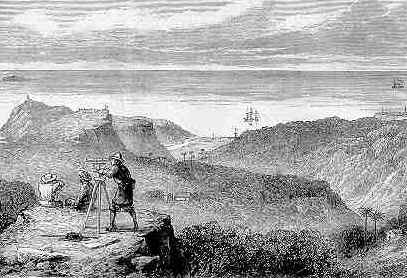
Triangulation on Rodriguez Island, from the Illustrated London News, 24 October 1874.source

To make things very short, Pingrés transit observation was doomed also by the weather and in some encyclopedias it was simply tagged as unsuccessful.

" On the fateful 6th of June the weather was generally unfavourable. At 5.30 am, the wind, which had blown hard during the night, calmed down somewhat, but there was a heavy cloud in the east, and a quarter of an hour later the sky was almost completely overcast. At the crucial time, between 8.00am and 8.30 am the clouds cleared sufficiently for observations to be made but the wind rose so strong, that Pingré was as much troubled by it as by the clouds with the result that the observation was far from satisfactory.Pingré made his observation "dans l'enfoncement de Francois Leguat", probably on the hill of the East to it."  (Source: North-Coombes)

A living Domed Rodrigues Giant Tortoise (Cylindraspis peltastes) depicted by Jossigny in c. 1770. 

Maybe he could not contribute with much related to the Transit of Venus itself but his account of the 3 and a half months in Rodrigues has proved valuable in many respects. First of all his second objective of his voyage to Rodrigues. He was determined to draw a map and so with his assistant he set out on several occasions taking angles in order to determine latitude and longitude. Lack of time and the capture of the island by the British Navy prevented Pingré, who was said not to aim much at accuracy, from drawing a more accurate map than he actually did. However, his Rodrigues manuscript was voluminous, containing, beside meteorological observations, a 100 pages alone of the island's capture.And we learn that during his visit Rodrigues had just a handful inhabitants, "a surgeon and a corporal in charge of a dozen slaves who were engaged in collecting tortoises for shipment to Isle de France." In 1761, Abbé Pingré wrote:

"The tortoise is not a pretty animal, but it was the most useful of those we found at Rodrigues. In the three and a half months that I spend on the island, we ate almost nothing else: tortoise soup, fried tortoise, stewed tortoise, tortoise forcemeat, tortoise eggs, tortoise liver - these were pretty much our only savouries. This meat seemed to me as good on the last day as on the first; I did not eat many of the eggs; the liver seemed to me the most delicious part of the animal. After five weeks stay I was attacked by dysentery which I kept secret, because I counted more on myself to heal it than the island's surgeon. Diet and rest put me right in a few days, but it left me with an extraordinary involuntary repugnance for this liver that I had so liked until then. Should I thus regard it as the cause of my indisposition?. . .Tortoise fat is very abundant and does not congeal; it is what is known as tortoise oil. This oil had no bad taste, it is very healthy, and we seasoned our salads with it, used it in frying and all our sauces. Rodrigues tortoises are foot and a half long and bout a foot across; they were formerly large, but they are no longer given time to grow. When a bigger one is found, it is called a carrosse. These carrosses cannot harm a waken man, though they have sometimes bitten sleepers hard. The shells of these tortoises served us like baskets to carry oysters and similar provisions. The flesh of these tortoises is the colour of mutton, and approaches it for taste." (Pingré, 1763; Cheke and Hume, 2008, found here).


Pingré mentioned not only the tortoises which at his time were still more or less abundant but also that other species mentioned by Leguat about 70 years earlier were not anymore to be seen, like the Rodrigues Night Heron.
source 

As to the second part of the Transit of Venus pair, Pingré was more successful.
"More satisfactory results were obtained from an expedition to the French Cape on Haiti where the next transit was observed on 3 June, 1769."(source)
Monument of Pingré in Rodrigues


The next Transit of Venus took place in 1874, and it was again observed by scientists sent to the island, this pic was sent to me by Brice, unfortunately without source


"Not far from Port Mathurin on Rodrigues, on a site where the old Fort Duncan was loacted, Charles B. Neate erected his observatory huts. The transit hut was enclosed by a large stone wall to protect it against hurricanes. On the morning of the transit, the observatory was surrounded by policemen and no one was allowed to approach. Neate observed with the 6-inch equatorial. At both ingress and egress the black drop was very apparent. Today, there is a plaque commemorating the event (with the wrong year 1894), attached to a large concrete block."


The transit hut at Point Venus, surrounded by a wall to protect the hut against hurricanes. (Picture courtesy of National Maritime Museum, London) 

The scene as it is today with the concrete block and plaque commemorating the event. 
Photo:Deva Ramasawmy, 2009
Tomorrow between 6.20 am and 8.00 am the Transit of Venus can hopefully be observed again in Rodrigues.

Sources:

- Alexandre Guy Pingré/ New Advent Encyclopedia